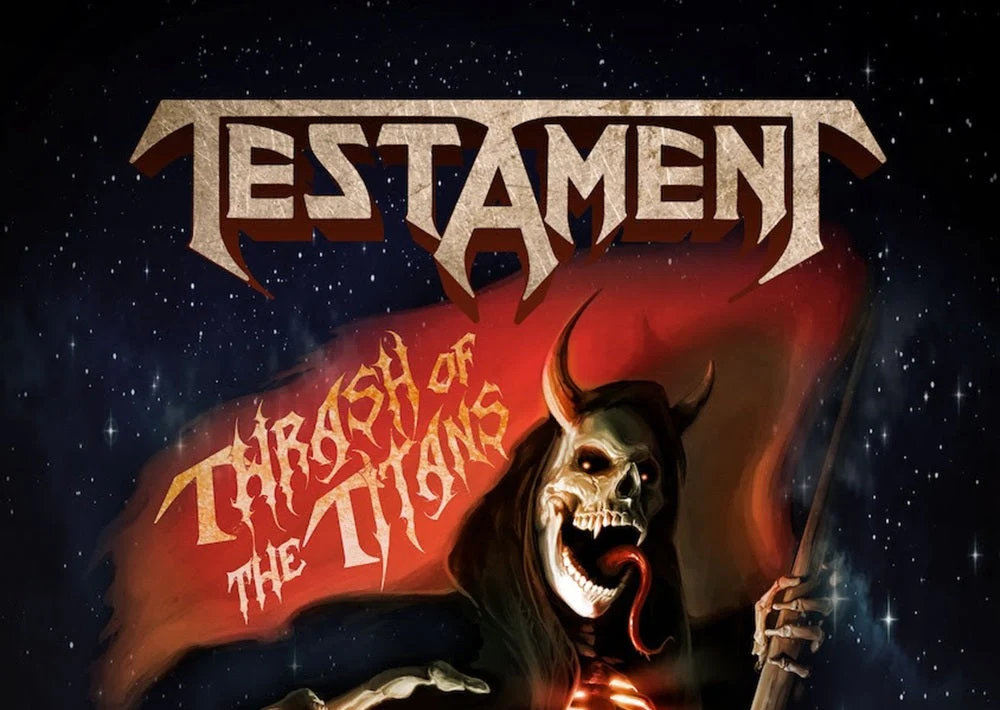
Metal does not exist in theory—it exists in motion, in sweat, in volume, and in the unfiltered reality of life on the road. That reality has now been captured with rare clarity and intention in Testament’s newly released Thrash of the Titans mini-documentary, a raw, unvarnished look at one of the most dominant touring forces in modern thrash. Released April 20, 2026, the film is not simply a recap of a tour—it is a full-access document of the mechanics, discipline, and intensity required to sustain one of the genre’s most enduring legacies.
For MetalMania Live, this release represents more than a piece of content. It is a defining artifact of what live metal truly is when stripped of polish and presented in its most authentic form. This is the exact ethos the station is built on—live recordings only, no studio substitutions, no compromises—and Testament’s latest visual offering aligns with that philosophy at the highest level.
The documentary centers on the opening night of the 2026 U.S. run, captured in Portland, Oregon on March 14. But what unfolds is far more expansive than a single show. The film adopts a “day in the life” structure, pulling viewers into the full operational cycle of a touring band that has long since moved beyond the novelty of the road and into something closer to a permanent state of motion. This is not glamour. It is routine, repetition, and resilience. It is early load-ins, soundchecks that double as recalibration sessions, and the constant negotiation between physical fatigue and performance precision.
What becomes immediately clear is that for a band like Testament, the road is not a temporary condition—it is a system. Every member, every crew position, every piece of gear functions within that system, and the documentary takes the time to show how those elements interact. Backstage preparation is not treated as filler; it is positioned as foundational.
The small moments—instrument tuning, setlist adjustments, pre-show communication—carry as much weight as the performance itself because they are what make that performance possible.
The on-stage footage, when it arrives, lands with greater impact because of this context. The transition from preparation to execution is seamless, reinforcing the idea that what the audience sees is only the final layer of a much deeper process. Testament’s performance is not just tight—it is engineered. Every tempo shift, every riff, every transition is delivered with a level of precision that reflects decades of refinement.
A central narrative thread within the film is the integration of drummer Chris Dovas, whose presence has added a new dimension to the band’s live dynamic. Described within the touring ecosystem as having “tightened the screws,” Dovas represents both continuity and evolution. His playing does not disrupt the band’s identity; it reinforces it, injecting additional speed, control, and intensity into a machine that was already operating at a high level. The documentary captures this transition in real time, showing how a lineup change is not just about personnel, but about recalibration—finding new balance within an established framework.
The broader context of the tour amplifies the significance of what is being documented. Thrash of the Titans was not a standard run of dates—it was a concentrated display of genre-defining power, bringing together Testament, Overkill, and Destruction in a lineup that reflects the core architecture of thrash metal itself. This was not nostalgia-driven programming. It was a reaffirmation of relevance, a demonstration that these bands are not legacy acts in the passive sense, but active forces continuing to shape the live metal landscape.
The timing of the tour and the documentary also aligns with the ongoing cycle of Testament’s fourteenth studio album, Para Bellum, released in October 2025. While the album provides the material foundation, it is the live translation of that material that defines its impact. The documentary makes it clear that songs do not reach their full form until they are tested on stage, where they are subjected to the energy of a live audience and the physical demands of performance. This is where MetalMania Live’s focus becomes critical—capturing those live interpretations, preserving them, and delivering them without dilution.
As the U.S. leg concluded on April 10 in Berkeley, the release of the documentary functions as a transition point rather than a conclusion. It bridges the domestic run with the upcoming European summer festival circuit, where Testament will carry this same intensity into larger stages and broader audiences. The film, in that sense, is both retrospective and forward-looking. It documents what has been achieved while setting the tone for what comes next.
For MetalMania Live, this moment is a perfect convergence of content and identity. The station’s commitment to live-only programming finds a direct parallel in the documentary’s approach. There is no attempt to sanitize the experience, no effort to smooth out the edges. What is presented is exactly what it is—loud, physical, demanding, and deeply human. It reinforces the idea that live metal is not just a genre category, but a distinct mode of expression that cannot be replicated in controlled environments.
The significance of Thrash of the Titans extends beyond Testament as a single band. It serves as a case study in how modern metal operates at scale while maintaining authenticity. It shows how touring infrastructure, lineup dynamics, and audience engagement all intersect to create a cohesive, high-functioning system. It also highlights the endurance required to sustain that system over time, particularly in a genre that demands both technical precision and physical intensity.
What emerges from the documentary is a portrait of a band that understands exactly what it is and what it needs to do to remain at the top of its field. There is no reinvention for its own sake, no deviation from core principles. Instead, there is refinement—an ongoing process of tightening, adjusting, and executing at a level that leaves little room for error.
As the summer festival season approaches, the energy captured in Portland is set to scale outward, moving from theaters to open-air stages, from concentrated tour runs to expansive multi-band lineups. The documentary ensures that the origin point of that momentum is preserved, providing both fans and observers with a clear view of how it all begins.
For those who engage with MetalMania Live, this is exactly the kind of material that defines the platform. It is not about abstraction or distance—it is about proximity to the real thing. It is about hearing and understanding what happens when a band steps onto a stage and delivers without compromise.
Testament’s Thrash of the Titans mini-documentary is not just a release—it is a benchmark. It sets a standard for how live metal can be documented, presented, and understood in 2026. And as the band moves forward into the next phase of its touring cycle, that standard will continue to resonate, amplified through every stage, every set, and every broadcast that captures it in its purest form.