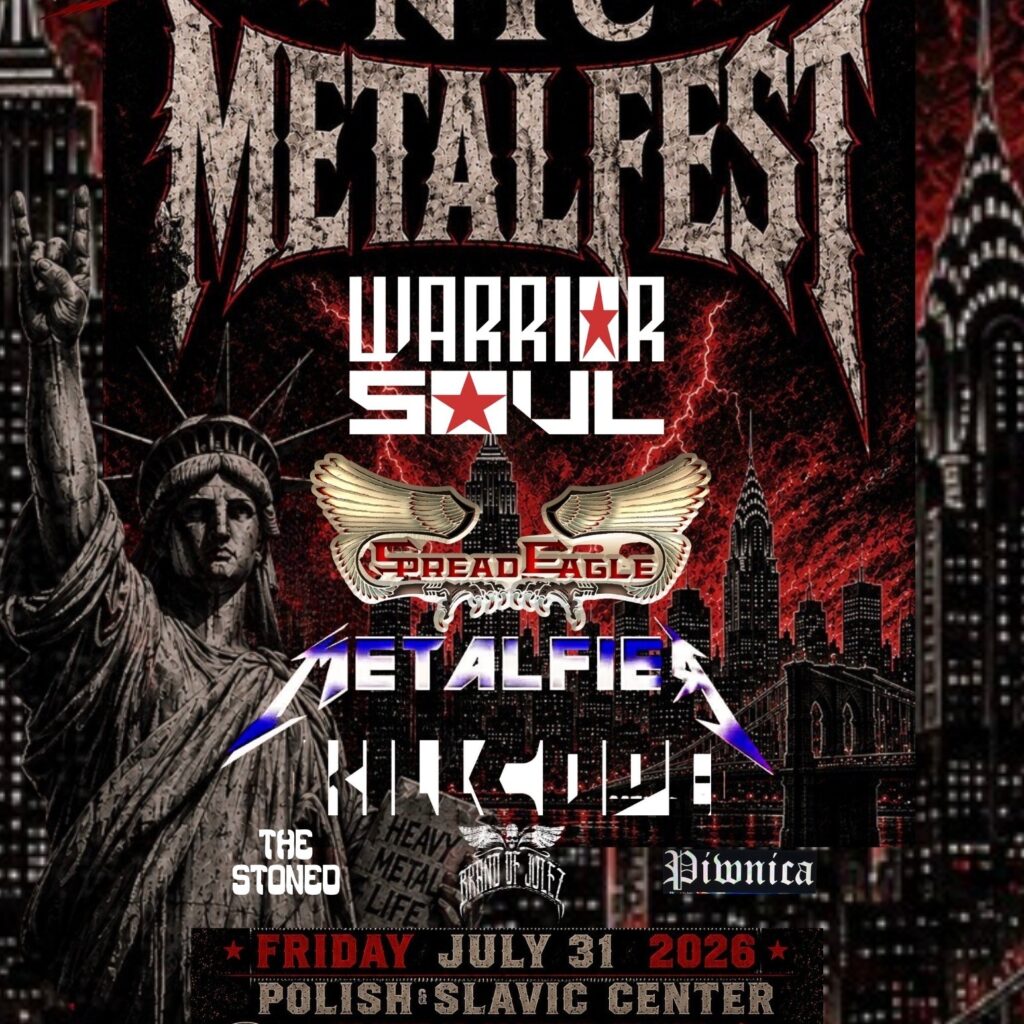
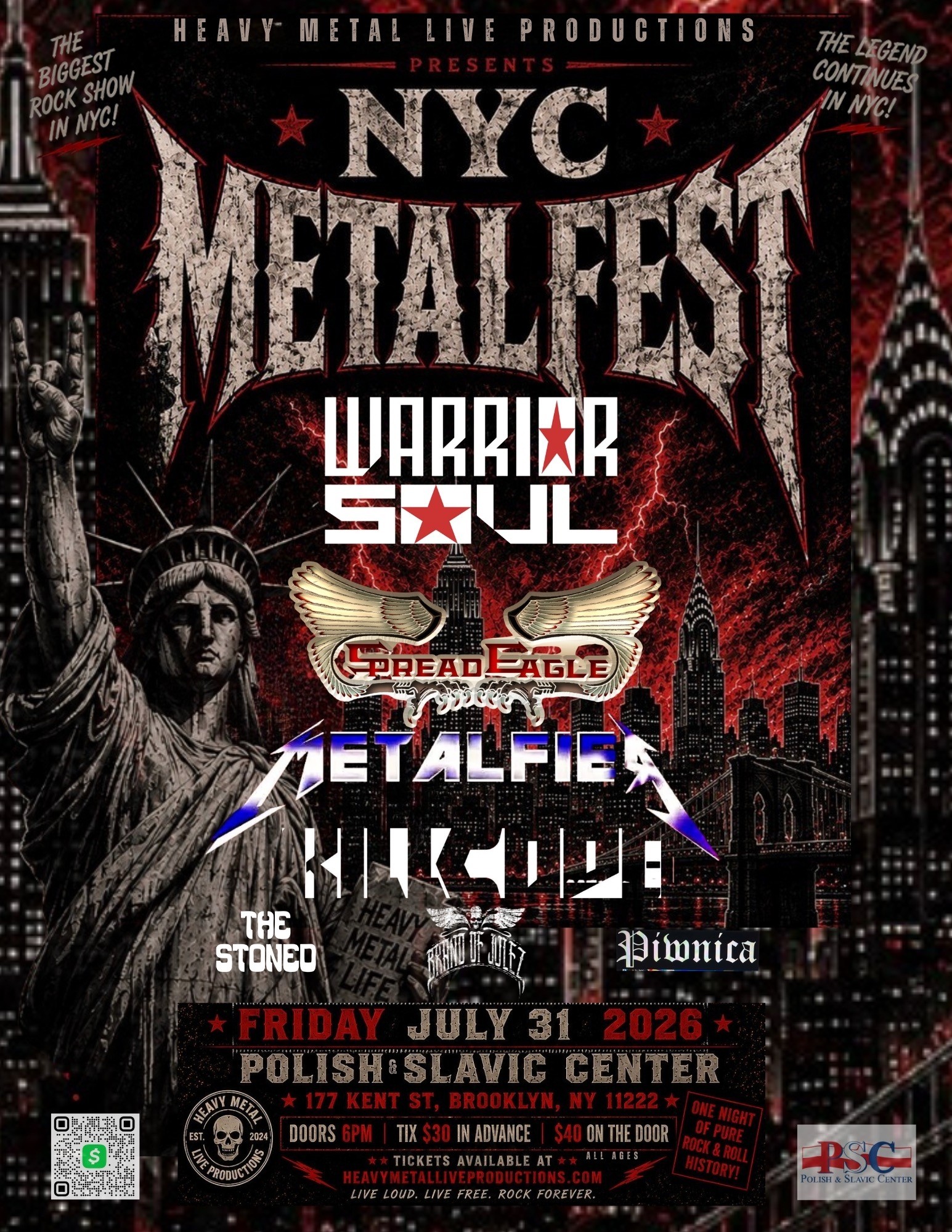
Brooklyn does not lack for rock clubs, warehouse venues, or DIY spaces built for loud music, but on Friday, July 31, one of the more unlikely rooms in the borough is set to host one of the summer’s most interesting regional metal lineups. NYC Metalfest takes over the Polish and Slavic Center in Greenpoint, transforming a building normally reserved for community gatherings and cultural events into a single night showcase of New York hard rock history alongside the acts still carrying that tradition forward today.
The choice of venue alone makes this one worth paying attention to. The Polish and Slavic Center sits at 177 Kent Street, tucked into a residential stretch of Greenpoint just across the East River from North Jersey, and it functions day to day as a hub for the neighborhood’s Polish community, hosting everything from cultural events to local gatherings. Turning that same space over to a lineup of hard rock and metal bands for one night gives the show a genuinely unusual atmosphere, closer in spirit to the kind of unpretentious, community hall gigs that defined the New York underground rock scene decades ago than anything resembling a typical club show. Doors open at six in the evening, and the bill runs seven bands deep across the night.
At the top of that bill sits Warrior Soul, a band whose history says as much about the volatility of the early 1990s New York rock scene as it does about frontman Kory Clarke himself. Clarke, a Detroit native who first made his way into music as a drummer before stepping out front, founded Warrior Soul in New York City in 1987 after a promoter at the city’s Pyramid Club bet him he could not put together the best band in town within six months. He proved the point emphatically, signing a multi album deal with Geffen Records within nine months of that bet and releasing the band’s blistering 1990 debut, Last Decade Dead Century, a record built around politically charged lyrics and an anarchic blend of hard rock and alternative metal that drew comparisons to the Stooges and MC5 as much as to any of their contemporaries. The album became a genuine sensation in the United Kingdom, where audiences embraced Clarke’s confrontational, insurrectionist songwriting even as the band’s fortunes in the United States were ultimately overshadowed by the rise of grunge. Warrior Soul pushed on through several more Geffen releases before dissolving in 1995, only for Clarke to revive the name in 2007 and keep it touring steadily ever since, most recently marking the band’s own 35th anniversary with UK dates last year. Decades removed from their early confrontations with the music industry, Clarke has grown more reflective about that period, acknowledging in recent interviews that some of his old antagonism toward other artists and the industry at large is something he now genuinely regrets, even as the political fire that defined his songwriting remains fully intact.
Sharing top billing is Spread Eagle, a band whose own origin story runs through Boston before landing squarely in New York City’s late 1980s hard rock scene. Guitarist Paul DiBartolo, bassist Rob De Luca, and drummer Tommi Gallo had all played together in the Boston band Bang before DiBartolo relocated to New York and connected with vocalist Ray West, whose voice impressed him enough to convince his former bandmates to follow him south and form a new group. That group became Spread Eagle, and within just a few months of forming, the band had already signed to MCA Records, an unusually fast turnaround that meant much of their self titled 1990 debut was actually written in the studio itself, out of both necessity and pure momentum. The album leaned into a raw, street level sound built around razor edged riffs and unapologetically gritty subject matter, anchored by the single Switchblade Serenade, which earned the band meaningful MTV airplay and helped cement their reputation as one of the rawer, more dangerous alternatives to the more polished Sunset Strip glam metal dominating the same era on the opposite coast. A second album, Open to the Public, followed in 1993 before the band went their separate ways, though Spread Eagle eventually reformed in the mid 2000s and has continued touring internationally in the years since, still built around the same unfiltered, no backing tracks approach to live performance that defined them from the start.
Rounding out the bill are two acts drawing more directly from today’s regional scene. Killcode, a five piece outfit based in New York City, brings a sound that blends southern rock influences with modern hard rock and metal songwriting, giving the night a heavier, more contemporary counterpoint to the vintage sleaze and hard rock energy of the headliners. Metalfier, meanwhile, represents the kind of long running local institution that keeps a regional scene alive between bigger touring cycles. Founded in 2007 by guitarist and vocalist Andrew Janda, the band has built its identity around a classic power trio format and a commitment to keeping straightforward, driving thrash and heavy metal alive in New York’s club circuit, even as the lineup surrounding Janda has shifted over the years. Filling out the rest of the bill are The Stones, Brand of Julez, and Piwnica, a local Greenpoint based band that has built a steady following performing regularly around the neighborhood, giving the night an unusually deep and community rooted supporting cast beneath its more recognizable headliners.
Taken as a whole, NYC Metalfest offers something a little different from the typical touring package show. It is a night built around New York’s own rock and metal lineage, pairing bands who lived through the city’s late 1980s and early 1990s hard rock explosion with the current generation of local acts still carrying that same unpolished, street level energy forward. Held in a room more accustomed to community gatherings than mosh pits, and situated close enough to draw easily from North Jersey as well as the rest of the city, the show carries the kind of intimate, slightly unlikely charm that has always defined the best nights in New York’s underground rock history.