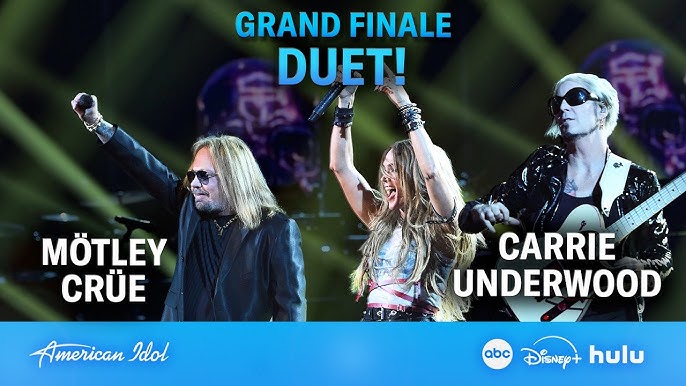
There are certain moments in modern music culture where worlds that traditionally operate in separate lanes suddenly collide on a massive public stage and force audiences to pay attention all over again. The American Idol Season 24 grand finale delivered exactly that kind of moment when legendary Sunset Strip shock-rock icons Mötley Crüe joined forces with country music powerhouse and former Idol champion Carrie Underwood for one of the most heavily debated live television performances of 2026.
Broadcast nationally on Monday night, May 11, the performance instantly became one of the defining viral music moments of the spring television season, not simply because of the unlikely crossover itself, but because it represented something much larger happening across modern entertainment. Legacy hard rock and heavy metal continue reclaiming mainstream visibility in ways few industry analysts predicted even a decade ago. From sold-out stadium tours to streaming surges, vinyl reissues, social media rediscovery, festival dominance, and major television placements, the classic heavy music machine is once again operating at full capacity.
The Idol finale performance opened with a dramatically restrained version of “Home Sweet Home,” instantly creating a sense of atmosphere that felt far more cinematic than viewers may have expected from a network television finale. Behind the piano introduction sat Tommy Lee, revisiting one of the most iconic openings in 1980s hard rock history while Carrie Underwood stepped directly into the emotional center of the performance. The decision to begin with a stripped-down approach before detonating into the explosive chaos of “Kickstart My Heart” ultimately mirrored the entire career arc of Mötley Crüe itself — theatrical, excessive, unpredictable, emotional, loud, and impossible to ignore.
Once the performance transitioned into full-throttle arena mode, the energy shifted immediately. Lee moved behind the drums, pyrotechnic energy surged through the stage production, and the medley transformed into a collision between country superstardom and Sunset Strip excess. Underwood shared lead vocal duties alongside Vince Neil, helping drive the choruses with the kind of power and precision that reminded audiences why she remains one of the strongest live vocalists in modern commercial music.
The pairing itself was not random. Longtime fans of American Idol history immediately recognized the deeper connection between Underwood and “Home Sweet Home.” Back in 2009, her own interpretation of the song became the official elimination anthem during a pivotal era of the show’s popularity. That association created a full-circle television moment that producers clearly understood would resonate emotionally with longtime viewers while simultaneously introducing younger audiences to one of the defining power ballads of the 1980s hard rock explosion.
What followed afterward online was equally revealing.
Within minutes of the broadcast ending, social media platforms exploded with reactions dissecting every aspect of the performance. The live audience inside the studio reportedly delivered a standing ovation, embracing the spectacle exactly as intended. Online discussion, however, became significantly more divided. Debate centered heavily around Vince Neil’s live vocal performance, with some longtime fans defending the raw authenticity of the appearance while critics across Reddit, X, and various music communities argued that Underwood largely carried the vocal weight of the set.
Yet in many ways, that controversy only amplified the performance’s success.
Mötley Crüe has never operated like a polished corporate machine designed for technical perfection. Their identity has always been rooted in chaos, danger, excess, unpredictability, attitude, and personality. That is precisely why the band became one of the defining forces of the glam metal era in the first place. Their appeal was never built entirely on pristine musicianship. It was built on atmosphere, rebellion, hooks, spectacle, and the feeling that absolutely anything could happen once the lights went down.
That mythology remains powerful in 2026.
The American Idol appearance also functioned as a strategic launch point for what is becoming one of the biggest legacy hard rock campaigns of the year. Mötley Crüe is now preparing to unleash “The Return of the Carnival of Sins” North American tour, a massive amphitheater run celebrating one of the most outrageous and commercially dominant live eras in the band’s history.
For longtime fans, the phrase “Carnival of Sins” carries enormous weight.
Originally launched during the mid-2000s reunion era, the original Carnival of Sins tour represented Mötley Crüe at their most unapologetically theatrical. Giant stage productions, fire, aerial stunts, oversized visual insanity, adult-themed spectacle, and full-scale rock-and-roll decadence transformed those performances into immersive arena events rather than standard concerts. The tour became legendary among fans because it embraced everything larger-than-life about the band without restraint or apology.
Now, two decades later, the return of that concept arrives during an entirely different cultural landscape where nostalgia has become one of the most commercially powerful forces in live entertainment. Audiences no longer attend legacy tours simply to revisit old songs. They attend to reconnect with entire emotional eras of their lives. Mötley Crüe understands that dynamic perfectly, and the 2026 tour appears designed specifically to maximize that emotional connection.
The upcoming 33-date North American run launches July 17 in Burgettstown, Pennsylvania before moving through major markets across the United States and Canada, including Toronto, Camden, Florida amphitheaters, Midwest stops, and a final West Coast conclusion in Ridgefield, Washington on September 26. Supporting acts Tesla and Extreme further reinforce the tour’s focus on pure hard rock nostalgia while simultaneously creating a package designed to appeal across multiple generations of rock audiences.
The Camden, New Jersey stop on July 27 is already emerging as one of the more anticipated East Coast dates, particularly for longtime tri-state area fans who witnessed Mötley Crüe’s original dominance during the MTV era. That market historically embraced the band heavily throughout the 1980s and 1990s, and the return of the Carnival of Sins production aesthetic should create one of the summer’s biggest hard rock concert spectacles.
The tour also strategically aligns with another major anniversary campaign: the release of the “Crücial Crüe 1981–1989” box set arriving globally on July 10 through BMG. More than a simple reissue package, the release functions as a full-scale celebration of the band’s commercial and cultural peak years, collecting the five studio albums that transformed Mötley Crüe from underground Los Angeles troublemakers into one of the biggest rock acts on the planet.
Those records document an extraordinary rise.
Too Fast For Love captured the dangerous DIY energy of the early Sunset Strip scene before glam metal fully exploded commercially. Shout At The Devil elevated the band into genuine superstardom through controversy, image, hooks, and dark theatricality. Theatre Of Pain pushed them further into MTV dominance while introducing emotionally driven crossover material like “Home Sweet Home.” Girls, Girls, Girls amplified the sleaze-rock mythology surrounding the group, while Dr. Feelgood ultimately perfected the formula commercially, becoming their biggest and most polished mainstream success.
Together, those albums generated more than 30 million sales globally and helped define the visual, sonic, and cultural identity of 1980s hard rock.
Collectors are already aggressively targeting the new configurations, particularly the ultra-limited Crüeseum edition restricted to only 250 hand-numbered units worldwide. The combination of scarcity, anniversary marketing, premium packaging, and renewed mainstream visibility has created significant anticipation among vinyl collectors and longtime fans alike. The picture-disc vinyl presentation especially aligns with the renewed collector culture surrounding legacy rock releases, where physical presentation has once again become central to the fan experience.
What makes all of this particularly fascinating in 2026 is the broader resurgence of heavy rock and metal culture happening across the entertainment industry. For years, mainstream narratives frequently framed classic hard rock as a fading format disconnected from younger audiences. That assumption now looks increasingly inaccurate. Legacy acts continue generating massive touring revenue, younger fans continue rediscovering classic catalogs through streaming algorithms and social media clips, and the appetite for authentic arena-scale spectacle appears stronger than ever.
Mötley Crüe sits directly in the center of that revival whether critics fully accept it or not.
Their ability to remain culturally visible decades after their commercial peak speaks to something deeper than nostalgia alone. The band represents a specific kind of rock-and-roll mythology that modern entertainment rarely produces organically anymore. Recklessness, danger, excess, imperfection, spectacle, and personality once formed the foundation of arena rock identity. In today’s highly managed entertainment environment, those traits often feel increasingly rare, which ironically makes bands like Mötley Crüe feel even more culturally distinct now than they did during their original rise.
That broader conversation about legacy, performance, authenticity, and endurance also ties directly into this week’s major programming spotlight on MetalMania Live itself.
This Friday night, MetalMania Live presents Metallica at Tropicana Field 1999: Unearthing a Soundboard Relic That Captures a Band Between Eras and At Full Power on MetalMania Live, a special broadcast diving deep into one of the most fascinating transitional periods in Metallica history. The late 1990s remain one of the most debated chapters in Metallica’s evolution, positioned between the massive commercial dominance of the Black Album era and the identity crisis conversations that surrounded the years leading into St. Anger.
Yet revisiting live recordings from 1999 often reveals a band still operating with overwhelming force onstage.
That era showcased Metallica balancing old-school thrash intensity with the larger groove-oriented production style that defined their stadium dominance throughout the decade. The Tropicana Field soundboard recording captures a group still performing with absolute command while navigating shifting fan expectations and changing industry landscapes. For MetalMania Live listeners, the broadcast represents more than a simple archival replay. It offers a snapshot of heavy metal history during a period where legacy, reinvention, mainstream visibility, and underground credibility constantly collided.
That same tension now surrounds many classic heavy acts entering 2026.
Fans debate vocals. They debate aging. They debate authenticity. They debate relevance. Yet audiences continue showing up in massive numbers because these bands still provide something modern entertainment often struggles to replicate: genuine cultural mythology.
Whether through Metallica’s late-1990s stadium dominance, Mötley Crüe’s reckless glam-metal spectacle, or the emotional crossover television moment created with Carrie Underwood on prime-time network television, heavy music continues proving its staying power in ways the industry repeatedly underestimates.
And as summer approaches, the combination of anniversary releases, major tours, rediscovered live recordings, and cross-generational collaborations is turning 2026 into one of the most fascinating years the classic heavy music world has experienced in decades.