Metallica at Tropicana Field 1999
 DJ Don Edwards
Metallica at Tropicana Field 1999: Unearthing a Soundboard Relic That Captures a Band Between Eras and At Full Power on MetalMania Live
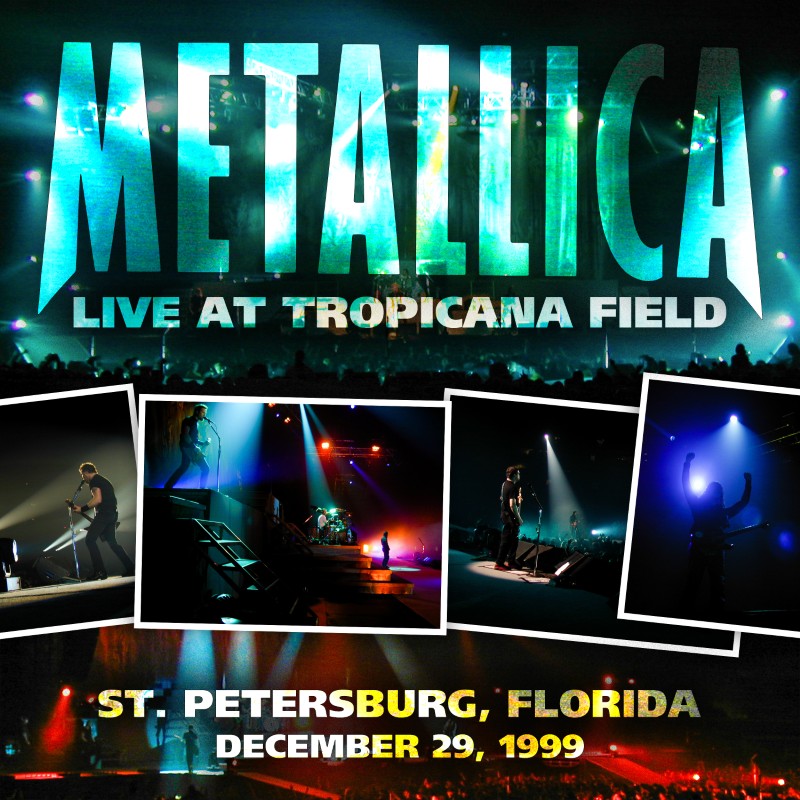
There is a distinct difference between a live recording that documents a performance and one that reveals a band in transition, operating with intent, edge, and total command of its catalog. The December 29, 1999 performance from Metallica at Tropicana Field in St. Petersburg, Florida belongs firmly in the latter category. Preserved from a soundboard DAT source and now resurfacing as a complete audio experience, this show stands as one of the most compelling late-1990s snapshots of a band redefining itself in real time. For MetalMania Live, where the focus remains exclusively on delivering authentic live recordings, this is not just another archival addition—it is a statement piece, positioned as a cornerstone of this week’s Friday Night Metallica Live broadcast.
By the close of the 1990s, Metallica had already reshaped the landscape of heavy music multiple times. From the thrash blueprint of the 1980s through the seismic shift of the Black Album era and into the experimental textures of Load, Reload, and Garage Inc., the band entered this performance with a catalog that demanded both range and authority. What makes the Tropicana Field show so significant is how seamlessly those eras coexist within a single set, delivered with a confidence that only comes from a band fully aware of its own evolution.
The performance opens with “Die, Die My Darling,” a charged and aggressive entry point that immediately establishes the tone. It is followed by “Fuel,” which injects a modern, high-octane energy reflective of the band’s late-90s direction. From there, “For Whom the Bell Tolls” and “The Four Horsemen” anchor the set in the band’s foundational era, creating a deliberate contrast that highlights the breadth of their sound without ever fragmenting the flow.
As the set progresses, the inclusion of “Whiskey in the Jar” and the percussive “Drum Doodle” segment underscores the band’s willingness to incorporate texture and variation into a stadium-scale performance. “2 x 4” and “No Leaf Clover” push further into the band’s evolving sonic palette, with the latter representing one of the more orchestral and expansive compositions in their live rotation at the time. The transition into “Sad But True” and “Creeping Death” re-centers the performance with unmistakable weight, reinforcing the band’s ability to shift gears without losing cohesion.
One of the defining stretches of the show arrives with “Bleeding Me” and the extended “Mastertarium” sequence, where the band leans into dynamics, tension, and release. These are not abbreviated versions—they are fully realized live interpretations that expand on the studio material, allowing the performance to breathe and build in a way that only a live setting can support. When “Blackened” closes out the main set, it does so with precision and intensity, setting the stage for a series of encores that elevate the performance even further.
The encore structure itself reflects the band’s command over its catalog and its audience. “Nothing Else Matters” introduces a moment of controlled restraint before “King Nothing” and “One” reintroduce scale and narrative depth. The second encore, featuring “Turn The Page” and “Enter Sandman,” bridges the band’s reinterpretive work with its most recognizable anthem, delivering a sequence that feels both reflective and definitive. By the time the “Encore Jam” unfolds and transitions into a final, unrelenting “Phantom Lord,” the performance has moved beyond a standard setlist into something more expansive—a complete, multi-phase live experience.
What elevates this recording is the soundboard origin itself. Captured directly from the mix, the audio delivers a level of clarity and balance that places the listener inside the performance. The guitars carry weight without distortion, the rhythm section is defined and present, and the vocals cut through with authority. This is not a distant or ambient recording—it is immediate, detailed, and immersive, preserving the integrity of the performance in a way that aligns perfectly with the MetalMania Live standard.
Within the broader framework of MetalMania Live programming, the Tropicana Field 1999 performance represents exactly what the platform is built to deliver: complete, unfiltered live shows that capture artists at critical moments in their trajectory. This is Metallica between eras—post-Black Album dominance, deep into their experimental phase, and still fully connected to the aggressive foundation that defined their rise. It is a rare alignment of history, performance, and recording quality that makes this show essential listening.
As this week’s Friday Night Metallica Live feature, the broadcast positions the Tropicana Field recording where it belongs—front and center, presented in full, and delivered without compromise. It reinforces a core principle that continues to define MetalMania Live: live music is not a supplement to the studio experience; it is the definitive version. Every transition, every improvisational moment, every shift in energy contributes to a narrative that can only be understood when the performance is experienced in its entirety.
At a time when much of music consumption is reduced to fragments and highlights, a complete recording like this carries a different kind of value. It preserves the architecture of the set, the pacing decisions, and the cumulative impact that builds from the first note to the final encore. For longtime fans, it is a return to a specific moment in Metallica’s evolution, captured with precision and clarity. For new listeners, it is an entry point into understanding how a band of this scale operates in a live environment—how it balances legacy with progression, and how it maintains intensity across nearly two hours of performance.
This week, MetalMania Live delivers that experience in full. A complete soundboard recording from a pivotal moment in Metallica’s history, presented as it was meant to be heard—direct, powerful, and uncompromising. It is not just a concert. It is a document of a band at a crossroads, performing with absolute authority, and leaving behind a recording that continues to resonate decades later.