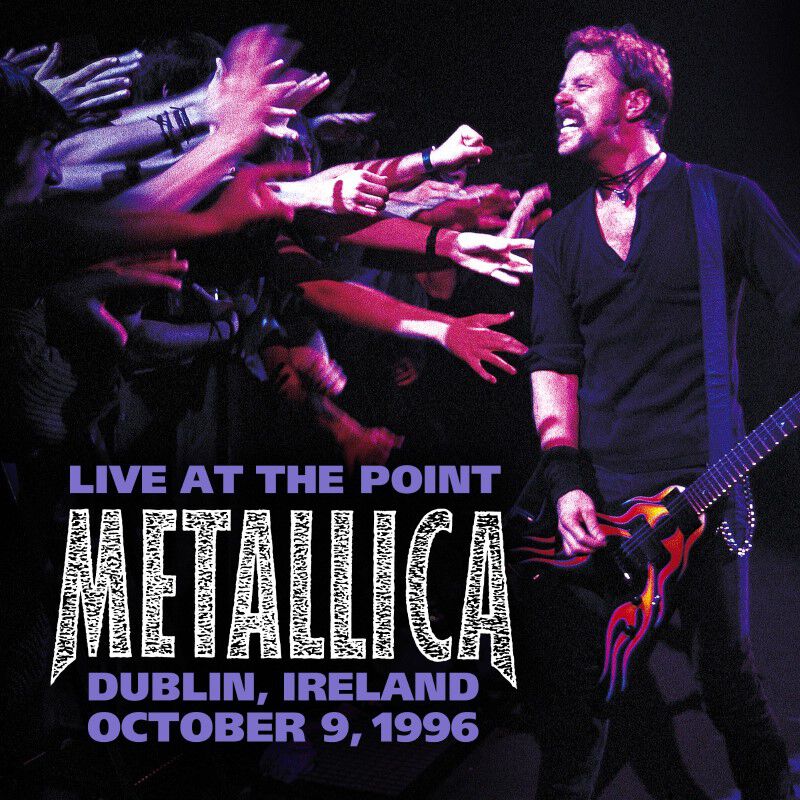
Metallica Live in Dublin 1996
 DJ Don Edwards
Metallica Live in Dublin 1996: A Defining Soundboard Era Performance That Captures the Band’s Evolution in Real Time on MetalMania Live
There are certain live recordings that function as more than historical artifacts—they serve as precise markers of transformation, capturing an artist at the exact moment where past identity and future direction collide. The October 9, 1996 performance from Metallica at The Point in Dublin, Ireland is one of those rare documents. Preserved as a full-length live recording and circulated through the band’s own broadcast ecosystem, this show stands as one of the most revealing snapshots of Metallica during a period of reinvention. Now positioned within the MetalMania Live rotation as a featured presentation, it represents a critical chapter in the evolution of live metal performance—and anchors this week’s Friday Night Metallica Live spotlight.
By late 1996, Metallica was operating in a space that few bands of their scale had ever navigated successfully. The release of Load had shifted the band’s sonic palette, introducing blues-infused structures, alternative textures, and a broader emotional range into a catalog previously defined by thrash precision and metallic aggression. The Dublin performance captures that shift not as a departure, but as an expansion—one that unfolds seamlessly within a setlist that bridges eras without hesitation.
The opening sequence immediately establishes the band’s intent. The Intro Jam transitions into “So What,” delivering a raw and confrontational entry point that signals this will not be a restrained performance. “Creeping Death” follows with unmistakable authority, grounding the set in the band’s early foundation before “Sad But True” reinforces the weight and density that defined their early-1990s dominance. By the time “Ain’t My Bitch” enters the sequence, the performance has already moved fluidly between eras, demonstrating a command over both legacy material and newer compositions.
As the set unfolds, the structure reveals a deliberate balance between intensity and atmosphere. “Whiplash” injects a surge of speed and aggression, while “Bleeding Me” expands the dynamic range, allowing the band to explore a slower, more immersive sonic space. “King Nothing” and “One” continue that progression, each track reinforcing a different facet of the band’s identity—groove, narrative, and precision coexisting within a single performance arc.
The mid-section of the show further emphasizes the band’s willingness to experiment within a live context. “Wasting My Hate” delivers a compact, high-impact burst, followed by a bass-driven improvisational segment that highlights the instrumental interplay at the core of the band’s sound. When “Nothing Else Matters” arrives, it does so not as a departure from intensity but as a controlled recalibration, setting the stage for “Until It Sleeps” and “For Whom the Bell Tolls,” which reintroduce tension and scale with measured precision.
What distinguishes the Dublin performance is its ability to sustain momentum while continuously evolving. “Wherever I May Roam” and “Fade to Black” deepen the emotional range, while the “Kill/Ride Medley” functions as both homage and reinvention—condensing the band’s early catalog into a high-impact sequence that maintains the aggression of the originals while adapting them to the current live framework.
The encore structure elevates the performance into something even more expansive. The transition from the “Encore Jam” into “Last Caress” and “Master of Puppets” reasserts the band’s thrash roots with unmistakable force, while “Enter Sandman,” delivered with full-scale intensity, reinforces its status as a defining live anthem. The subsequent post-encore sequence, including “Am I Evil?,” “Breadfan,” and “Motorbreath,” pushes the performance beyond a conventional closing, extending the experience into a final, unrelenting stretch that leaves no aspect of the band’s catalog untouched.
From a sonic perspective, the recording captures the band with clarity and immediacy. The soundboard quality ensures that every layer of the performance is preserved—the interplay between guitars, the precision of the rhythm section, and the vocal delivery that anchors each transition. This is not a distant or ambient document; it is a direct, immersive representation of the performance as it unfolded, aligning perfectly with the MetalMania Live standard of delivering live music in its most authentic form.
Within the broader context of MetalMania Live programming, the Dublin 1996 show represents a critical piece of the platform’s identity. It is a recording that captures a band at a pivotal moment, navigating change while maintaining the core elements that defined its rise. It reinforces the platform’s commitment to presenting complete live performances that reveal the full scope of an artist’s capability—not isolated highlights, but continuous, fully realized experiences.
As this week’s Friday Night Metallica Live feature, the Dublin performance takes on added significance. It serves as both a historical document and a contemporary listening experience, reminding audiences that the power of live metal is not confined to a single era. Instead, it is an evolving force, shaped by performances like this—where risk, reinvention, and mastery converge on stage.
At a time when music consumption often prioritizes brevity over depth, a complete recording like this offers something fundamentally different. It preserves the architecture of the set, the pacing decisions, and the cumulative energy that builds across more than two hours of performance. For those who have followed Metallica’s trajectory, it provides a detailed look at a transformative period. For those discovering the band through live recordings, it offers a comprehensive introduction to what defines their enduring impact.
This week, MetalMania Live brings that experience forward in full. A complete performance from a defining era, presented without compromise, and positioned exactly where it belongs—at the center of the live metal conversation.